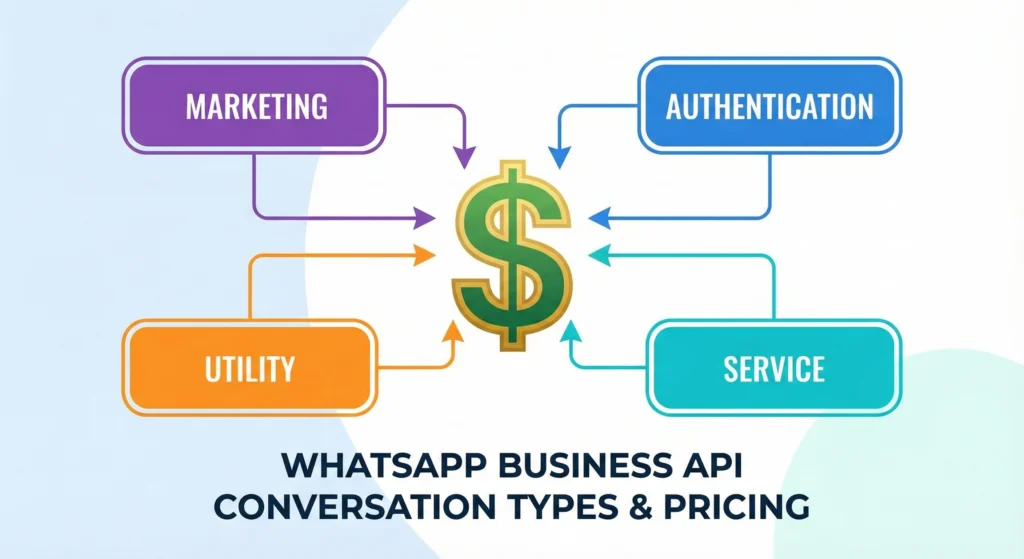
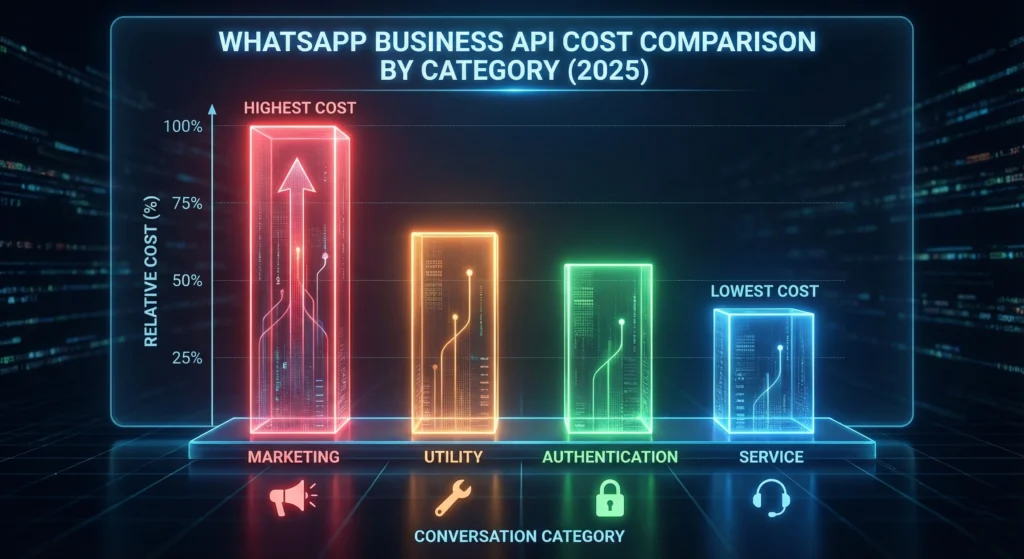
The cost of the WhatsApp Business API in 2025 is determined by the conversation category and the customer’s country code. Meta charges businesses per 24-hour conversation window, which begins when a business sends a template message. There are four distinct pricing categories: Marketing (highest cost), Utility (moderate cost), Authentication (variable cost), and Service (free or low cost). Understanding these
categories is the only way to accurately predict your monthly messaging budget.
This guide breaks down every cost factor you need to know for the 2025 fiscal year. We will look at the new July updates, specific regional costs, and how to save money.
Quick Summary: 2025 WhatsApp Business API Cost Structure
In 2025, Meta has refined how they charge for messages. You no longer pay a flat fee for every message. Instead, you pay based on the goal of the conversation. If you send a sale offer, you pay a marketing rate. If you send a receipt, you pay a utility rate.
The 4 Core Conversation Types Defined
- Marketing: Messages sent to generate sales. This includes promotions, offers, welcome messages, and abandoned cart reminders. These are the most expensive.
- Utility: Messages that facilitate a specific, agreed-upon transaction. This includes order confirmations, shipping updates, and billing statements.
- Authentication: Security messages used to verify users. This is almost exclusively for One-Time Passcodes (OTPs) and account recovery steps.
- Service: User-initiated conversations. This happens when a customer messages you first to ask for help. These are often free or very cheap within a 24-hour window.
Data Snapshot: Base Exchange Rates for Key Regions
Rates fluctuate based on currency exchange, but here is a snapshot of the relative cost index for 2025.
- North America (USA/Canada): Low cost per conversation.
- Western Europe (UK/Germany): High cost for Marketing, moderate for Service.
- India: Very low cost for Utility but increasing rates for Marketing.
- Indonesia & Brazil: Moderate costs, heavily tiered based on volume.
Critical Update: The July 1, 2025 Pricing Model Change
Starting July 1, 2025, Meta is adjusting how “conversation windows” work for specific categories. Previously, opening a conversation allowed for unlimited template exchanges in 24 hours. The new update shifts focus on volume and frequency.
Analysis: The Shift from Conversation Bundles to Per Message Logic
The biggest change in 2025 is the move toward “Per-Message Logic” for high-frequency Marketing. In the past, you could open a 24-hour marketing window and send three templates. Now, Meta encourages a stricter limit.
If you send multiple Marketing templates that are not related, you may trigger a new charge sooner. However, for Utility and Service conversations, the 24-hour session rule remains strict to protect customer experience. This ensures businesses do not spam users under the guise of a “Service” window.
Old Model vs. New 2025 Model Cost Comparison
| Feature | Old Model (Pre-2025) | New Model (2025) |
| Billing Trigger | First template delivered | First template delivered (category specific) |
| Marketing Window | 24 Hours (Unlimited templates) | 24 Hours (Subject to frequency caps) |
| Utility Pricing | Flat rate per session | Volume-based tiers (cheaper at scale) |
| Free Tier | 1,000 Service conversations | 1,000 Service conversations (User Initiated only |
Understanding the New Volume-Based Tiers for Utility
For businesses sending massive amounts of transaction updates, 2025 brings good news. Utility conversations now have volume tiers.
If you send over 100,000 utility messages (like receipts) in a month, the cost per conversation drops slightly. This encourages businesses to move all transactional SMS traffic to WhatsApp. To take advantage of these savings, you should review your provider’s structure. Check out Waplify’s Plans & Pricing to see how these tiers apply to your business.
Detailed Pricing Breakdown by Conversation Category
To budget effectively, you must understand the rules for each category. Meta’s system automatically detects the category based on your template content.
Marketing Conversations: Costs for Promotions, Offers, and Upsells
Marketing is the premium tier. This includes any message that does not directly facilitate a current order.
- Examples: “Flash Sale! 50% off,” “Hey, you left this in your cart,” or “New Collection Drop.”
- Cost Factor: This is the most expensive category. Meta charges more here to prevent spamming users.
- Strategy: Only send these to segmented, high-intent lists.
Utility Conversations: Transactional Rates for Post Purchase Updates
Utility messages are functional. They relate to a transaction that has already happened or is currently happening.
- Examples: “Your order #123 has shipped,” “Here is your monthly bill,” or “Check-in for your flight is open.”
- Cost Factor: Lower than marketing.
- Rule: You cannot include upsells here. If a shipping update says, “Check out our new arrivals,” it becomes a Marketing conversation.
Authentication Conversations: Domestic vs. International Rate Spikes
Authentication is strictly for security.
- Examples: “Your verification code is 8492.”
- Cost Factor: Rates vary wildly. Domestic OTPs (sending to a number in your own country) are cheap. International Authentication rates are much higher in 2025 to prevent SMS pumping fraud.
- Billing Logic: If you verify users globally, expect your authentication costs to be higher than your utility costs.
Service Conversations: Utilizing the Free 24-Hour Window
Service conversations are special because the customer starts them.
- Examples: A user types “Where is my order?” or “I need help.”
- Cost Factor: First 1,000 service conversations each month are usually free. After that, they are very low cost.
- The Window: When a user messages you, you have 24 hours to reply. This opens a “Service” window. You can send free-form messages (not templates) during this time.
Global Pricing Tiers: A Geo-Specific Rate Card
Where your customer lives dictates the price you pay. It does not matter where your business is located.
High-Volume Markets: India, Brazil, and Indonesia Pricing
These countries have the highest WhatsApp usage in the world. Because the volume is so high, the per-message cost is generally lower than in Europe.
- Trend: Marketing rates in India are rising slightly to combat spam, but Utility rates remain very competitive.
- Brazil: Very strict rules on marketing frequency, but highly engaged users.
Tier 1 Markets: USA, Canada, and Western Europe Pricing
These are mature markets.
- USA/Canada: Uniquely, SMS is still popular here. To compete, WhatsApp keeps rates lower than expected.
- Western Europe (Germany, UK, France): These regions have strict privacy laws (GDPR). The costs are higher, especially for Marketing conversations.
Rest of World: Emerging Market Rates Explained
For countries not listed in the major tiers, Meta applies “Rest of World” rates. These are generally averages. If you are targeting regions like Nigeria, South Africa, or parts of Southeast Asia (Vietnam, Thailand), you will find rates that sit between India and Europe.
Developer Corner: Implementing 2025 Billing Logic
Developers need to set up their systems to track these costs in real-time. You cannot rely solely on the monthly invoice.
Code Logic: Differentiating Authentication-International Headers
In 2025, you must flag authentication templates correctly in your API calls. When sending an OTP, ensure your template category is set to AUTHENTICATION. If you send an OTP using a UTILITY template to save money, Meta’s AI will likely block the template or charge you the Marketing rate as a penalty.
Webhooks: Tracking Real-Time Spend via API
You should configure your Webhooks to listen for conversation status updates.
- Event: conversation.origin.type
- Action: Log this field. It will tell you if the conversation was classified as marketing, utility, authentication, or service.
- Benefit: This allows you to build a dashboard that shows your marketing team exactly how much they spent today.
Strategic Cost Optimization: Expert Tips
You can lower your WhatsApp bill without sending fewer messages. It requires smart management of your templates.
Audit Your Templates: Moving Content from Marketing to Utility
Many businesses accidentally write Utility messages that sound like Marketing.
- Bad (Classified as Marketing): “Your order is confirmed! Get 10% off your next order with this link.”
- Good (Classified as Utility): “Your order is confirmed. You can track your shipment here.”
- By removing the promotional language, you switch the category from Marketing to Utility, saving roughly 40-50% on that conversation
Leveraging Waplify Plans for Lower Markups
Official WhatsApp Partners (BSPs) pay Meta directly. Some charge a markup on every message you send. Others, like Waplify, offer plans that help you manage these costs transparently. Using a provider with low or zero markup on the conversation fee is the easiest way to save money.
Comparative Analysis: Choosing Your WhatsApp Marketing Partner in India
If you are operating in high-volume markets like India, the partner you choose matters immensely. Some partners offer better analytics to track you spend, while others offer better compliance tools. For a deep dive into selecting the right vendor, read Choosing Your WhatsApp Marketing Partner in India a Comparative Guide to Features and Compliance.
Compliance and Pricing: Avoiding Category Penalties
Breaking the rules does not just get you banned; it costs you money. Meta monitors your “Quality Score.”
Aligning Content with the WhatsApp Business API Compliance Checklist 2025
If users report your messages as spam, your quality score drops. When your score is low, Meta may limit the number of messages you can send per day. This destroys your ROI.
To ensure your templates are safe and categorized correctly, follow the WhatsApp Business API Compliance Checklist 2025. This list helps you avoid common triggers that get templates rejected or misclassified.
How Green Tick Verification Affects Messaging Limits and Tiering
Getting the “Green Tick” (Official Business Account) increases user trust. While it does not directly lower the price per message, it drastically improves your read rates. Higher read rates mean better ROI for every dollar spent.
Furthermore, verified businesses often get approved for higher messaging limits faster. If you want to scale up your campaigns, check out the WhatsApp Green Tick 2025: Guide, Eligibility & How to Apply.
Case Study: Budgeting for High-Volume Campaigns in 2025
Imagine a fashion retailer planning a “Summer Sale.”
- Target: 10,000 customers in the UK.
- Content: A photo of a dress and a “Shop Now” button.
- Category: Marketing.
- Estimated Cost: 10,000 x (UK Marketing Rate).
The Optimization Strategy:
Instead of sending the Marketing message to everyone, they first sent a Utility message (order update) to 2,000 recent buyers. 500 of those buyers replied with “Thanks.” This opened a Service window. The brand then sent the Summer Sale info to those 500 people for free because it was within the open service window. They only paid the Marketing rate for the remaining 8,000 users.
Frequently Asked Questions (FAQ)
Q: Is the first 1,000 conversations free for Marketing?
A: No. The free tier of 1,000 conversations applies only to Service (user-initiated) conversations. You pay for Marketing messages from the very first one.
Q: What happens if I send a Marketing template inside a Utility conversation?
A: A new 24-hour Marketing window will open immediately, and you will be charged the Marketing rate. This essentially “overrides” the cheaper Utility window.
Q: Can I change a template category if Meta gets it wrong?
A: Yes. You can appeal the category decision in the WhatsApp Manager within your Meta Business Suite.
Conclusion: Future proofing Your WhatsApp Strategy
The 2025 pricing model rewards relevance and punishes spam. By understanding the four conversation types—Marketing, Utility, Authentication, and Service—you can predict your costs and optimize your spending.
Focus on moving as much traffic as possible to Utility and Service categories by stripping out unnecessary promotional language from transactional alerts. Audit your templates regularly, choose a transparent partner like Waplify, and always keep an eye on your quality score. Smart budgeting today ensures your campaigns remain profitable tomorrow.