

WhatsApp marketing platforms for education are specialized software tools designed to help schools, colleges, and EdTech companies communicate with students and parents at scale. These platforms replace traditional email and SMS by using the WhatsApp Business API to send bulk notifications, automate
admission queries and manage student support. The top solutions in this space include Waplify, Respond.io, Gallabox, and WATI*, each catering to different institutional needs ranging from cost-effective automation to large-scale enterprise management.
Introduction: The Communication Crisis in Modern Education
Schools today is facing a major disconnect. Administrators send out important announcements, but nobody reads them. The traditional methods of talking to students are failing. To fix this, institutions are moving to where the students actually are their phones.
The goal is to increase engagement rates. When a college sends an admission offer or a deadline reminder, it needs to be seen instantly. This section explores why old methods are dying and how new technology is saving the enrollment process.
Why Email Open Rates are Plummeting for Gen Z Students
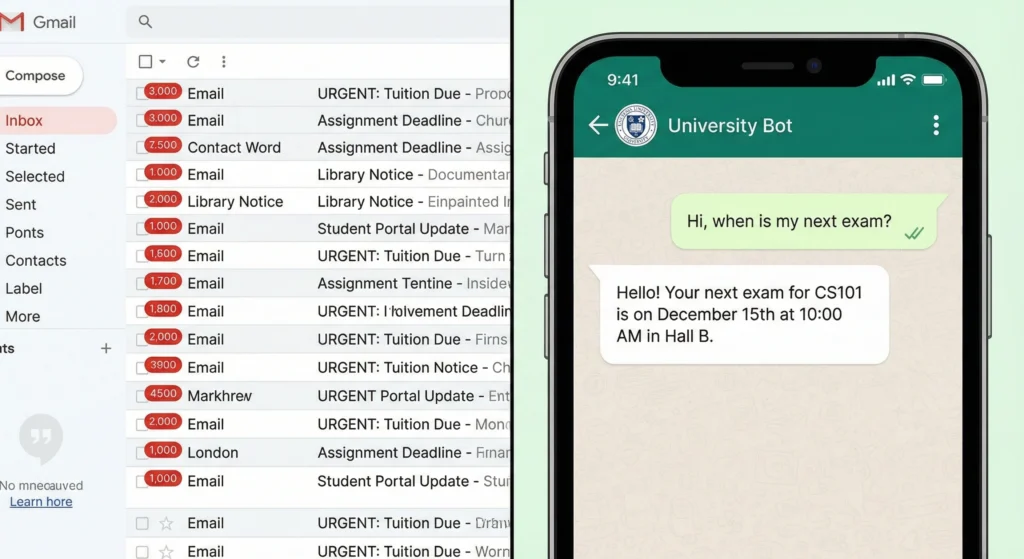
For Gen Z students, email is often seen as “junk mail.” Studies show that email open rates for universities have dropped significantly, often hovering below 20%. Students view email as formal, slow, and easy to ignore.
Because of this, critical information gets lost. Scholarship deadlines are missed, and enrollment steps are forgotten. Schools relying only on email are losing potential students to competitors who communicate faster.
The Shift to WhatsApp Business API for Campuses
To solve the engagement, drop, campuses are adopting the WhatsApp Business API. Unlike the standard WhatsApp app on your phone, the API allows for advanced software connections. It lets schools send thousands of messages at once and use chatbots to answer questions 24/7.
This shift results in open rates of over 90%. It turns communication from a one-way announcement into a two-way conversation. This is vital for modern student recruitment and retention.
Quick Verdict: Top WhatsApp Marketing Platforms for Education at a Glance
Choosing software can be overwhelming. There are many options, but only a few are optimized for the education sector. Below is a quick summary of the four market leaders to help you decide quickly based on your institution’s size and budget.
If you are looking for a tool that balances power with a unique payment model, you should explore Waplify However, different schools have different needs. Here is how the top contenders stack up.
Best for Cost-Effective Scaling & ROI: Waplify
Waplify.io stands out for budget-conscious institutions. It offers powerful automation without monthly subscription fees for the software license. This makes it perfect for private colleges and coaching centers that need high Return on Investment (ROI).
Best for Large Enterprise Universities: Respond.io
Respond.io is built for big teams. If you are a major university with a global presence and dozens of support staff, this tool helps organize thousands of conversations. It connects many different messaging channels into one inbox.
Best for Specialized EdTech Automation: Gallabox
Gallabox is designed with custom workflows in mind. It is great for EdTech companies that need to automate complex tasks like exam scheduling within WhatsApp. It uses “no-code” bots that are easy to deploy for specific educational tasks.
Best for Small Tutoring Centers: WATI
WATI is known for simplicity. It is an excellent choice for small K-12 schools or local tuition centers. The interface is clean and easy to learn, making it perfect for teams with limited technical skills.
Critical Selection Criteria: What Schools Must Look For
Before buying software, school administrators need a checklist. Education has strict rules regarding data and money. You cannot just pick any marketing tool; it must fit the specific workflow of a campus.
You need to evaluate how the software handles student data and how much it costs over time. Here are the four most important factors to consider during your search.
LMS and SIS Integrations (Canvas, Blackboard, PowerSchool)
Your marketing tool should talk to your existing systems. Schools use Learning Management Systems (LMS) and Student Information Systems (SIS) to track grades and attendance.
The best WhatsApp platforms integrate with tools like Canvas or Blackboard. This allows you to trigger a WhatsApp message automatically when a student misses a class or gets a new grade. Check out the Features of potential tools to ensure they support these connections via webhooks or API.
Data Privacy Compliance (FERPA, GDPR, and Minors)
Schools deal with sensitive data and minors. In the US, you must comply with FERPA. In Europe, it is GDPR.
The platform you choose must encrypt data. It should also have features to mask phone numbers so staff members cannot see personal contact details of students unnecessarily. Security is non-negotiable.
Drip Campaign Capabilities for Admission Nurturing
Admissions is a long process. You cannot just send one message and hope a student enrolls. You need a drip campaign. This is a sequence of automated messages sent over weeks.
For example, message one introduces the school. Message two shares a campus tour video three days later. Message three reminds them of a deadline. To learn how to structure these effectively, read this WhatsApp Drip Campaigns Guide.
Affordability and Payment Models (Subscription vs. One-Time)
Budgets in education are often tight. Most software charges a monthly fee per user. This can get expensive if you have a large admissions team.
Some platforms offer a one-time payment for the software license. This can save schools thousands of dollars annually. Always calculate the total cost of ownership for at least three years.
Deep Dive: Waplify – The Budget-Friendly Powerhouse
Waplify has carved a niche by addressing the biggest pain point for schools: recurring costs. By removing the monthly software rental fee, it allows institutions to spend their budget on ad spend rather than tools.
It is designed to be robust enough for bulk messaging but simple enough for admission counselors.
Unique Selling Proposition: The One-Time Payment Advantage
Most competitors charge monthly subscriptions that increase as your contact list grows. Waplify offers a distinct model. You pay once for the software access.
This is critical for schools that have seasonal budgets. You do not have to worry about losing access to your data during the summer months when cash flow might be lower. You can review the Waplify’s Plans & Pricing to see the difference.
Feature Spotlight: Automating Admission Drip Campaigns
Waplify excels at automation sequences. You can upload a list of prospective students and set up a schedule of messages. The system handles the rest.
If a student replies, the automation stops, and a human counselor takes over. This ensures that staff only spend time on students who are truly interested, boosting productivity.
Ideal For: Private Colleges, Coaching Institutes, and Bulk Messaging Needs
This platform is the top choice for mid-sized private colleges and coaching institutes. These organizations often have high volumes of leads and need to send bulk updates without worrying about per-contact subscription fees.
Deep Dive: Respond.io – The Enterprise Omnichannel Inbox
Respond.io is a heavy hitter in the messaging space. It does not just do WhatsApp; it handles Facebook Messenger, Instagram, and more. For universities with international students, this is a major benefit.
However, this power comes with a higher price tag and a steeper learning curve.
Strengths: Centralizing International Student Recruitment Channels
International students use different apps. Students in China use WeChat, students in Europe use WhatsApp. Respond.io brings all these chats into one screen. This prevents the admissions team from having to log into five different websites to answer questions. It streamlines the workflow for global recruitment teams.
Weaknesses: Higher Cost of Entry for Local Schools
The pricing model for Respond.io is geared toward enterprise businesses. For a local school or a small district, the monthly fees can be prohibitive. The cost per “monthly active contact” can rise quickly during enrollment season.
Ideal For: Global Universities with Large Support Teams
If your university has a dedicated IT team and an admissions department with over 20 staff members, Respond.io is a strong contender. It offers advanced reporting and role management suitable for large hierarchies.
Deep Dive: Gallabox – The EdTech Specialist
Gallabox focuses heavily on being a conversational commerce tool, which translates well to EdTech. Their chatbots are very advanced and can handle transactions and bookings natively within the chat.
It is a great tool for digital-first education companies.
Strengths: Pre-built Bots for Exam Scheduling and Fees
Gallabox offers templates. You can quickly set up a bot that lets a student pick an exam slot or pay a tuition installment without leaving WhatsApp. This reduces friction. The easier you make it to pay or schedule, the more students will do it.
Cons: Complexity for Non-Technical Admin Staff
Because the bots are powerful, setting them up can be tricky. While they claim to be “no code,” a non-technical school administrator might struggle with the logic flow. You might need a developer to help with the initial setup.
Ideal For: Online Learning Platforms and EdTech Startups
This platform fits businesses that sell courses online. If your “school” is entirely digital, Gallabox’s ability to automate the sales and booking process is invaluable.
Deep Dive: WATI – The SMB Solution
WATI (WhatsApp Team Inbox) is one of the most popular tools because it is straightforward. It focuses purely on WhatsApp and does it well.
It is an “official” partner solution that emphasizes ease of use over complex features.
Strengths: Simple User Interface for Quick Setup
You can get WATI running in less than an hour. The dashboard is colorful and intuitive. Teachers and admin staff can learn how to send a broadcast message with very little training.
Cons: Limited Automation Depth for Complex Student Lifecycles
WATI is great for basic alerts. However, if you need complex “if/then” logic for a student’s journey (e.g., “If they fail a quiz, wait 2 days, then send a resource”), WATI’s automation builder can be limiting compared to Waplify or Gallabox.
Ideal For: K-12 Schools and Local Training Centers
For schools that just need to send snow day alerts, report card reminders, and answer basic parent questions, WATI is the safe, reliable choice.
Comparative Analysis: Features vs. Pricing Matrix
To make the best choice, you must compare the hard numbers. Messaging costs and feature sets vary wildly between these providers.
Below is a breakdown of how they compare on key metrics.
Comparing Bulk Messaging Costs and Limits
All these platforms use the Meta API, so the base cost per message is similar. However, some platforms add a markup on top of the message fee.
Platforms like Waplify usually offer zero markup on messages, meaning you pay exactly what Meta charges. Others may bundle message credits into expensive tiers.
API Stability and Customer Support Response Times
Education is time sensitive. If the system goes down during admission week, it is a disaster. Enterprise tools like Respond.io generally have higher uptime guarantees, but they may take longer to reply to small support tickets compared to agile teams like Waplify or Gallabox.
Table: Feature Breakdown (CRM Integration, Chatbots, Broadcasts)
| Feature | Waplify | Respond.io | Gallabox | WATI |
| Pricing Model | One-Time / Lifetime | Monthly Subscription | Monthly Subscription | Monthly Subscription |
| Ideal User | Private Colleges / High ROI | Global Universities | EdTech / Online Courses | K-12 / Tutors |
| Automation | Advanced Drip Campaigns | Cross-Channel Workflows | Transactional Bots | Basic Autoreplies |
| Mobile App | No | Yes | Yes | Yes |
| Setup Speed | Fast | Slow (Complex) | Medium | Fast |
Strategic Implementation: How to Use These Platforms Effectively
Buying the tool is only the first step. You must use it strategically to see results. Do not just use WhatsApp as a text message replacement; use it as a marketing channel. Here are three high-impact strategies to implement immediately.
Running WhatsApp Drip Campaigns for Student Enrollment
Create a sequence for interested students. Start with a warm welcome. Follow up with success stories of alumni. End with a clear call to action to apply. Automation ensures no student is forgotten.
Automating Fee Reminders and Administrative Alerts
Chasing late fees is difficult. Set up an automated reminder that goes out 3 days before tuition is due. Include a direct payment link. This simple step can reduce late payments by over 40%.
Alumni Engagement and Fundraising via Direct Messaging
Alumni ignore emails, but they check WhatsApp. create a broadcast list for alumni updates. When it is time for fundraising, send a personalized message asking for support. It feels more personal and yields higher donation rates.