
WhatsApp OTP is a secure verification method that uses the WhatsApp Business API to send one-time passwords directly to a user's WhatsApp app instead of their SMS inbox. This method offers significantly higher delivery rates, end-to-end encryption, and a smoother user experience compared to traditional SMS. Businesses use it to verify user logins, confirm transactions, and secure account access with greater reliability.
The Shift from SMS to WhatsApp Authentication
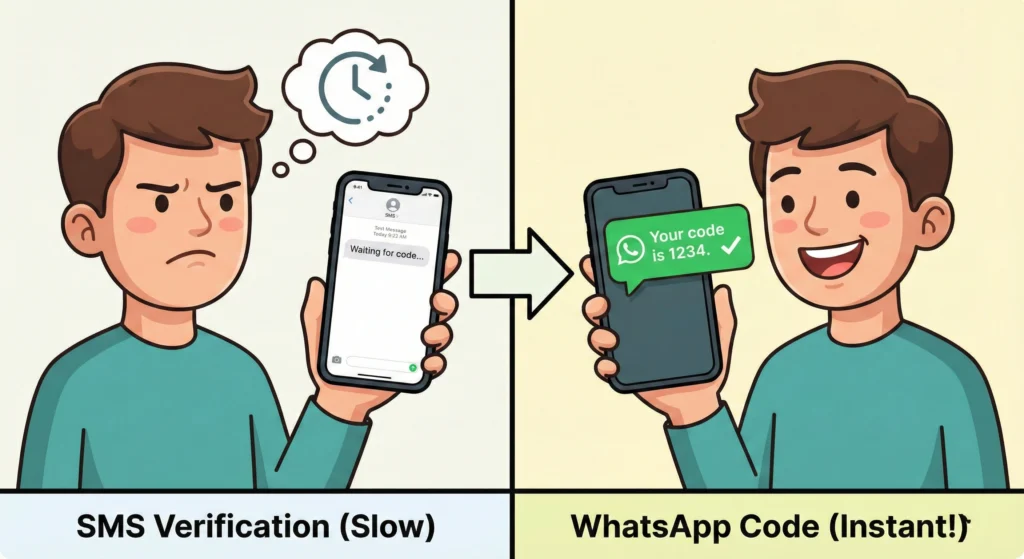
For years, SMS was the standard for sending verification codes. However, SMS has major flaws. Codes often get lost due to poor network coverage, spam filters, or carrier blocking. This leads to user frustration and lost customers.
The industry is now shifting rapidly to WhatsApp Authentication. Because WhatsApp works over the internet (Wi-Fi or data), it does not rely on cellular signal strength in the same way SMS does. This change improves security and makes it easier for customers to verify their identity quickly.
Top WhatsApp OTP Providers at a Glance (Executive Summary)
If you are looking for a quick answer on which provider to choose, here is the executive summary.
- Best Overall for Scalability & Price: Waplify. It offers the most competitive rates and developer-friendly tools.
- Best for Large Enterprises: Twilio. Known for its massive global reach and established infrastructure.
- Best for Global Routing: MessageBird (Bird). Great if you need complex fallback logic across many countries.
- Best for Non-Tech Teams: Wati. A user-friendly interface that requires little coding knowledge.
Delivery Rates, Cost, and Key Differentiators
Choosing the right provider depends on your budget and technical needs. The table below compares the top players in the market.
| Provider | Delivery Rate Est. | Cost Model | Key Differentiator | Best For |
| Waplify | ~98-99% | Low Markup + Meta Rates | High Reliability & Low Cost | Startups & Scaling SMBs |
| Twilio | ~96-98% | Usage-based (Higher) | Global Carrier Network | Enterprise Corporations |
| MessageBird | ~97% | Usage-based | Omnichannel Routing | International Brands |
| Wati | ~95% | Subscription + Usage | No-Code Dashboard | Marketing Teams |
What is WhatsApp OTP? Understanding Meta's Authentication Templates
A WhatsApp OTP is not just a standard message. It uses a specific format defined by Meta called an Authentication Template. This template is designed strictly for security.
The Mechanics of the 'Authentication' Conversation Category
Meta categorizes WhatsApp conversations into four types: Marketing, Utility, Authentication, and Service.
Authentication conversations are unique. They allow businesses to authenticate users with one-time passcodes, potentially at multiple steps in the login process like account verification, account recovery, and integrity challenges. You cannot mix marketing content into these messages. Meta strictly monitors this to prevent spam.
The User Experience: 'Copy Code' Button vs. Zero-Tap Verification
The user experience on WhatsApp is superior to SMS.
- Copy Code Button: When the message arrives, it includes a dedicated button. The user simply taps "Copy Code" and pastes it into your app.
- Zero-Tap (One-Tap) Verification: In some advanced implementations (Android only), the OS can automatically detect the code and verify the user without them needing to tap anything. This reduces friction significantly.
Why the Green Tick Matters for OTP Trust and Conversion
- When a user receives a code from a random number, they might feel unsafe. However, WhatsApp allows businesses to apply for a Green Tick Verification badge.
- This badge appears next to your business name. It proves to the user that the code is coming from a legitimate source. This visual proof increases trust and ensures users complete the verification process.
WhatsApp OTP vs. SMS: A Data-Driven Breakdown
Why should you switch from SMS? The data clearly shows that WhatsApp wins in three key areas: delivery, cost, and safety.
Delivery Rates: Overcoming SMS Latency and Filtering
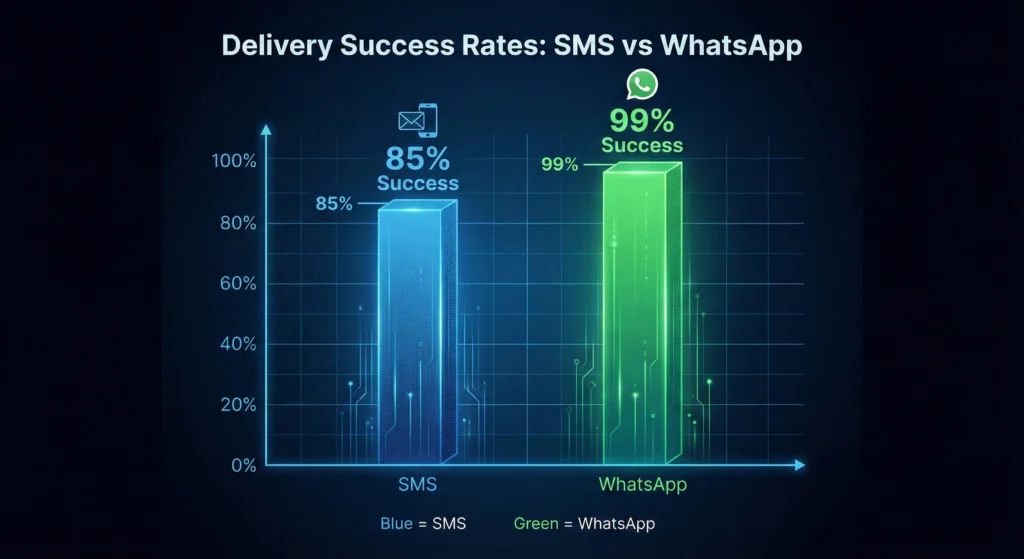
SMS delivery rates often hover around 85% to 90%. In some regions, this drops lower due to carrier filtering. WhatsApp OTPs consistently achieve delivery rates above 98%. Since the message travels over the internet, it bypasses the issues associated with cellular tower congestion.
Cost Efficiency: Analyzing Price Per Verified User
At first glance, SMS might look cheaper per message. However, you must look at the price per verified user. If you send 100 SMS codes and only 80 arrive, you have to pay to resend the missing 20. With WhatsApp, nearly every message arrives the first time.
Furthermore, pricing models are changing. To understand the specific costs associated with different regions and categories, reviewing the WhatsApp Business API Pricing 2025: Your Definitive Cost … guide helps clarify how Meta charges for these specific authentication conversations.
Security: End-to-End Encryption vs. GSM Vulnerabilities
SMS signals can be intercepted. Hackers can use techniques like "SIM Swapping" to steal SMS codes. WhatsApp messages are end-to-end encrypted. This means only the business and the user can read the code. Not even WhatsApp or the provider can see the content of the OTP, making it much more secure.
Comprehensive Comparison of Best WhatsApp OTP Providers
Let’s dive deeper into the specific strengths of the top providers in the market.
Waplify: Best for Affordable Scalability and Developer Support
Waplify focuses on making the WhatsApp API accessible and affordable. They provide a robust infrastructure that ensures high delivery speeds, which is critical for OTPs. If an OTP takes more than 10 seconds, the user often leaves.
Waplify offers very competitive pricing structures that are ideal for growing businesses. For a detailed breakdown of their costs, you can check the Waplify's Plans & Pricing. Their API is developer-friendly, making integration quick.
Twilio: The Enterprise Standard for Global Reach
Twilio is a giant in the communication space. They are excellent for massive enterprises that need to send millions of messages across every country. Their documentation is extensive. However, their pricing is often higher than smaller competitors, and their support can be slower for non-enterprise clients.
MessageBird (Bird): Strongest for International Routing
MessageBird, now known as Bird, excels at routing. If a WhatsApp message fails (which is rare), they have sophisticated logic to fall back to SMS or Voice instantly. This is great for international companies operating in regions with unstable internet connections.
Wati: Best for Non-Technical SMB Teams
Wati is built for teams that do not have a large developer staff. It is a "no-code" platform. While they support OTPs, their primary strength is in the user interface for customer support and marketing. If you need a simple solution and are okay with slightly higher subscription fees, Wati is a solid choice.
Feature Availability and API Robustness
This matrix helps you compare the technical features of each platform.
| Feature | Waplify | Twilio | MessageBird | Wati |
| API Speed | Fast (<2s) | Standard | Standard | Slower |
| Fallback Logic | Customizable | Built-in | Advanced | Basic |
| Setup Time | Instant | Medium | Medium | Fast |
| Support | 24/7 Priority | Ticket Based | Ticket Based | Email/Chat |
WhatsApp OTP Gateway Pricing Models Deconstructed
Understanding the bill can be confusing. It is usually a mix of Meta's fees and the provider's fees.
Meta's Official Authentication Rates vs. Provider Markup
Meta charges a specific rate for Authentication Conversations. This rate varies by country. For example, sending an OTP to a user in India costs differently than sending one to the UK.
Providers then add a markup. Some charge a small fee per message, while others charge a monthly subscription. It is vital to compare these markups. For specific insights into regional variances, especially in high-volume markets, the India WhatsApp Marketing: Features Comparison Guide offers excellent context on how regional pricing structures work.
Understanding the 24-Hour Session Window in OTP Contexts
Usually, WhatsApp conversations open a 24-hour window where you can chat freely. However, Authentication templates are different. They are strictly one-way utility messages. You do not open a marketing window with an OTP. This restriction keeps the cost of authentication messages lower than marketing messages.
Reviewing Free WhatsApp OTP Provider Options and Limitations
Are there free providers? Generally, no. Because Meta charges a fee for every conversation, no legitimate provider can offer unlimited free OTPs. Some providers might offer a "free tier" for the software usage, but you will still have to pay the Meta conversation fees directly.
Technical Implementation: Integrating the WhatsApp OTP API
Integrating WhatsApp OTP is straightforward for developers. Here is how it works.
Prerequisites: Business Verification and Template Approval
Before you send a single code, you must:
- Create a Meta Business Manager account.
- Verify your business (upload legal documents).
- Submit an Authentication Template to Meta for approval. This usually takes a few minutes.
Code Snippet: Sending a One-Time Password (JSON Example)
Here is a simplified JSON example of what the API request looks like when sending a code using a standard template.
{ "messaging_product": "whatsapp", "to": "15550001234", "type": "template", "template": { "name": "auth_code_template", "language": { "code": "en_US" }, "components": [ { "type": "body", "parameters": [ { "type": "text", "text": "123456" } ] } { "type": "button", "sub_type": "url", "index": "0", "parameters": [ { "type": "text", "text": "123456" } ] } ] } }Setting Up Intelligent Fallback Logic (WhatsApp to SMS)
Even with 99% delivery rates, you need a backup plan. If a user does not have WhatsApp installed, the message will fail.
Your system should detect this failure via a webhook. If the WhatsApp message status returns as "failed" or "undelivered" after 20 seconds, your code should automatically trigger an SMS via a secondary API. This ensures 100% verification coverage. You can read more about how APIs handle these workflows in the WhatsApp API vs. 3rd-Party: Travel Booking Confirmations article, which discusses reliability in critical messaging.
How to Choose the Right WhatsApp OTP Service
Making the final decision requires looking at three non-negotiable factors.
Evaluating Latency: The 10-Second Rule
Speed is everything. If an OTP takes 30 seconds to arrive, the user thinks your app is broken. Test the provider’s latency. The code should arrive within 5 to 10 seconds max.
Compliance Check: GDPR and SOC2 Considerations
You are handling sensitive user data (phone numbers). Ensure your provider is GDPR compliant. They should not store user data longer than necessary.
Support Quality: Troubleshooting Failed Deliveries
When OTPs fail, your user growth stops. You need a provider that answers the phone or chat immediately. Reliability is crucial, much like in the education sector where timely alerts are mandatory. For a look at platforms that prioritize uptime and support, see the Best WhatsApp Marketing Platforms for Education guide.
Securing Your Future with the Right OTP Partner
Switching from SMS to WhatsApp OTP is one of the easiest wins for modern businesses. It lowers costs, improves security, and provides a better user experience.
Key Takeaways for Decision Makers
- Don't ignore the Green Tick: It builds trust instantly.
- Compare the "All-in" Price: Look at Meta fees plus provider markups.
- Prioritize Speed: Latency kills conversion rates.
- Have a Backup: Always implement SMS fallback for non-WhatsApp users.
By choosing a provider like Waplify, you get the balance of cost and performance needed to scale your user verification securely.